
Film Collector Guides
1973 Box Office: A Collector's Reference for 2026
Look up a 1973 release
Search all 81 films in this release schedule.
Reported domestic box office to date, in nominal US dollars. These are not earnings confined to calendar 1973.
81 films; missing amounts remain not reported.
No matching film. Clear the search to see all entries.
Download the full CSV 81 films, with source links and missing values preserved.
Source: The Numbers' 1973 North American release schedule. Film titles link to its individual records.
By Movie Collection · Last updated
How to read these figures12
- Reading the 1973 box office table
- The Exorcist and the late-year release problem
- Domestic box office, worldwide gross and profit
- Why The Numbers records can differ from other charts
- Reissues, The Exorcist and the film on your shelf
- Using the 1973 box office for a watchlist
- American Graffiti, Robin Hood and title matching
- Method for this 1973 box office reference
- Citing The Sting without losing the scope
- Saving a useful copy of The Numbers comparison
- Questions about The Exorcist and the chart
- Verdict: use the 1973 box office to find the film
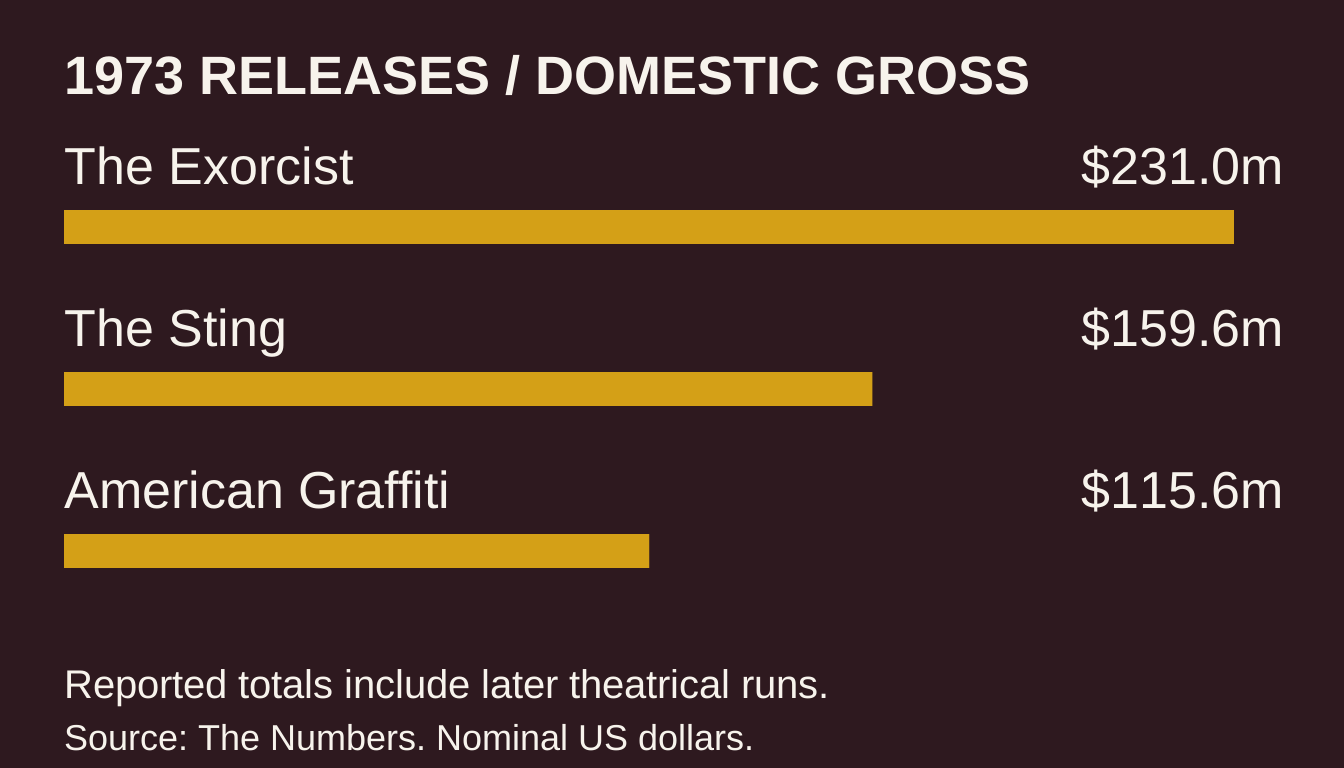
The 1973 box office gives you a way into a rich year of films. The Exorcist leads the reported domestic totals in the source below, ahead of The Sting and American Graffiti. That order can help you choose a film to research. The label on the money matters just as much as the order.
The table covers films in The Numbers' North American release schedule for 1973. Its figures are reported domestic box office to date, in nominal US dollars. Later theatrical runs may contribute to a film's total. A blank source value means not reported, not zero. Use the chart to compare that defined group, then check the cut and contents of a disc on its own.
Reading the 1973 box office table
Read the source group before reading the rank. The table gathers the films on The Numbers' North American release schedule for 1973. It keeps every listed film, including those without a reported gross. The default order puts the largest known totals first. It leaves missing values at the end.
This is a release-schedule group. It is not a record of all money taken at cinemas between the first and last days of that year. A film can begin a long run near the end of December. Its later receipts can then form part of the total on its film record. The release year and the period over which it earned money answer different questions.
The search field matches a film's title. Use it when you have a name from a review or an old shelf list. Clear the field to see the whole set again. The title sort is useful when you are matching entries in a catalog. The gross sorts compare only the reported amounts; neither assigns a value to a missing result.
The CSV has the same records as the page. Each row includes the film, its reported amount where one exists, the measure and the film's source URL. A blank numeric cell is deliberate. Keep it blank when you import the file into a sheet. Replacing it with zero would change the meaning of the record and the order of any later chart.
You can use the table with JavaScript switched off. The full list and CSV link still work; the search and sort controls need JavaScript. No account, email address or payment is required to read the figures. The page's source links let you inspect a title in more detail when its amount raises a question.
The Exorcist and the late-year release problem
The Exorcist's release date shows why a year label needs care. Its individual record at The Numbers lists a domestic release on December 26, 1973. The same record lists later domestic runs. The total beside its title therefore cannot serve as a daily account of what it earned before that December ended.
The film's reported domestic total is $231,020,723. Use the whole label with the number: domestic box office to date. Do not shorten that to money earned in 1973. Those two claims look close in a sentence, but they require different records. A release date plus a lifetime total does not supply a calendar-year series.
The Sting makes the same point. Its source record lists a domestic release on December 25, 1973. It belongs in this release-year group, yet that fact does not limit its total to the few days left in the year. Compare it with The Exorcist using the same total-to-date column, rather than trying to assign either film's whole gross to December.
For a collection note, write the film's year in the title field and the money's scope in a separate field. That keeps the identity of the film stable even if the financial record changes. It also lets you use the same film entry for a reissue, a restoration or a later disc without treating each as a new original film.
An old review may simply call a film the year's biggest hit. Before repeating that wording, check which chart it meant. It might refer to a release group, a territory or a particular run. This reference supports the narrower claim that The Exorcist has the largest reported domestic total in this source group. It does not turn that into every possible ranking of the year.
Domestic box office, worldwide gross and profit
Compare the same column with the same column. This reference uses the source's domestic box office measure throughout. It does not add international receipts to one film while leaving them out of another. A larger worldwide figure on a different page may be valid on its own, but it is a different measure from the one used here.
Live and Let Die is a useful example. Its film record separates the domestic total from the international and worldwide figures. That separation matters when you compare it with another film. Pulling the worldwide number into a domestic list would make the row look stronger through a change of scope rather than a change in the underlying result.
Gross means receipts before the costs and revenue splits needed to work out profit. A production budget alone does not supply all those terms. Do not subtract a budget from a theatrical gross and call the remainder studio profit. Marketing costs, distribution terms and the share kept by cinemas would need their own evidence.
The figures here are nominal US dollars. They keep the dollar values as reported rather than converting them to today's money. An inflation-adjusted chart answers a different question and must state its method. It may use a price index or a ticket-price model. Do not place its output beside an unadjusted amount without saying how the two differ.
Ticket sales are another measure again. A gross is a money amount, not a head count. Dividing it by a guessed ticket price would produce an estimate with its own limits. This table supplies no admissions estimate. It also gives no streaming revenue, television sales or physical-disc revenue; those do not belong in a theatrical box-office column.
Why The Numbers records can differ from other charts
A different total can come from a different scope. Check that before choosing which one to use. A chart may include an added run, use a worldwide total or reflect an older version of a record. Another may convert the money or round the result. The film's title can match while the quantities still differ.
Keep one source and one definition across a comparison. That is why this table preserves the amounts in one release schedule. It does not choose the largest figure found for each film. Such a list would reward whichever title had the broadest or newest record, without giving you a fair measure for the other rows.
The source's current domestic total may include later runs where those are recorded. You should not assume it includes every screening ever held. Historical records can have gaps. A clear label tells you what the source reports; it cannot make the source complete. If you need the revenue from one particular run, look for that run's own record.
Small reported amounts need the same care. A low figure is not proof that few people saw the film at all. It may reflect the part of its theatrical history available in that record. A missing figure tells you even less. Neither gives you a sound basis for calling an unseen film a failure or deciding it has no audience.
Keep the source URL with a copied figure. If a later check shows a change, you can return to the record and compare the labels. Avoid merging two old notes by adding their amounts unless the source proves the periods do not overlap. Two different totals can cover much of the same run. Adding them could count the same receipts twice.
Reissues, The Exorcist and the film on your shelf
A theatrical reissue and a disc edition are separate records. The Exorcist's source lists a later run under the name Extended Director's Cut. That label helps explain its release history. It does not establish the cut on a disc sold under a similar title. That disc's transfer and extras need their own checks too.
Begin with the film you want to own. Match the full title and original year, then the director or cast when needed. The Exorcist record credits William Friedkin as director and William Peter Blatty as screenwriter. Those film credits help identify the work. They do not identify a particular pressing of a disc.
Next check the version on the package. A theatrical cut and an extended cut can share artwork or a broad anniversary label. Look for the version named on the back cover, in the publisher's listing or on the disc itself. If the evidence does not say which cut is included, leave that field open rather than filling it from the box-office record.
Check the format on its own too. DVD, Blu-ray and 4K Ultra HD are not names for different theatrical revenue records. A film's financial success does not prove that a particular package contains all those formats. Read the contents of the actual offer. A picture of several cases is not a complete contents list.
Our disc-edition research guide gives you a place to start those checks. Use it to compare the release country and publisher, then the region and languages. Check the extras too. Keep those details beside the edition you might buy. The box-office figure belongs with the film's history, where it remains useful without promising anything about a particular disc.
Using the 1973 box office for a watchlist
Start with the kind of viewing you want, then use the chart as context. The largest gross is one route into the year, not a verdict on which film you will enjoy most. You might begin with The Exorcist, The Sting or American Graffiti, then follow a subject or a cast member into another title.
Keep a wanted list separate from your owned list. A film found in this reference is a research lead. It becomes an owned copy only when you have the actual edition. That distinction helps when you save a store page or compare two packages. It also makes it easier to spot a duplicate before you buy it.
A useful watchlist has a film field, an edition field and a reason to watch. Put the exact title in the film field. Keep your personal note in the reason field. A statement such as 'compare with another late-year release' describes your plan; it does not claim the films have the same story, audience or release pattern.
For the edition field, start with what you can verify. A publisher's page or a clear back-cover image may identify the cut and the languages. A used listing may need a photo of the disc label as well. A bare title and a stock image leave more open questions. Do not let a familiar film name stand in for those checks.
Once you own the copy, record its location. The case and shelf reference helps with the physical side of a collection. Keep the original insert with its case where possible. A financial chart can help you select a film, but it will not tell you whether a loose disc matches a sleeve in a second-hand lot.
American Graffiti, Robin Hood and title matching
Use the full film identity when a title is common. Robin Hood is a good example: the table points to the source's 1973 film record. The same character appears in other films. A search result that shows only the name may lead to a different work, a boxed collection or an unrelated release.
American Graffiti shows another trap. A film and its sequel can share much of a title. Keep the full name when you search and match the year in the film record. A result for More American Graffiti is not a substitute just because the words American Graffiti appear in it. A financial total from that result would belong to the other film.
Translated and alternate titles need the same treatment. Use the source link to identify the work first. Then compare the cast or director with the edition you have found. A translated name on a cover may be correct, but a title-only match cannot prove it. Keep the alternate name as an extra field rather than overwriting the original name.
The source schedule also reflects North American releases. That release year can differ from a film's first release elsewhere. Andrei Rublev appears in this schedule, while its linked film record identifies an earlier year. Its presence here follows the schedule's scope. It does not mean the film was first made or first shown anywhere in the world in 1973.
That is why the CSV keeps source URLs instead of assigning a new original year to every row. Use the schedule to research this market's releases and use an individual film record for its identity. Keep those two facts apart in your catalog. It is better to retain both than to force every date into one year field.
Method for this 1973 box office reference
The table retains all 81 film entries on the fetched source schedule. Of those, 30 have a reported domestic gross and 51 have no amount in that column. Those counts describe this page's source cohort. They are not a claim that only this many films existed, opened worldwide or earned money during the year.
We copied the film titles, linked records and reported domestic amounts. We sorted the numeric values for the default view and placed missing amounts last. No blank amount became zero. No worldwide total was substituted. The page and CSV use the same local data, so a download does not silently change the measure or drop the unknown rows.
The chart rounds its displayed amounts to one decimal place in millions. The table and CSV preserve the reported whole-dollar values. The bars use those unrounded values for their relative widths. The chart therefore gives you a quick view of the leading reported totals, while the table supplies the exact figure for a citation or a collection note.
The default order is a comparison within the reported source records. It is not a complete ranking of every film's true earnings. Missing data cannot establish a rank. A film with no amount remains visible by name so you can see that it was included in the schedule and follow its record without mistaking absence for a measured result.
Use the source's label when citing a row: film title, reported domestic box office to date, nominal US dollars. Cite the individual record or the release schedule according to the claim you make. For a figure used in new research, reopen that source. A retained copy is useful for showing what you read; it is not proof that a live record has stayed the same.
Citing The Sting without losing the scope
If you use The Sting in a film note, copy the meaning of the column along with the figure. A note that says 'reported domestic box office to date' stays clear when you move it from a table into prose. A note that says only 'made this much' leaves the market and time period open to guesswork.
Keep the film's title linked to its own record. Use the release schedule link for a claim about its place in this group. Those links do different jobs. The first identifies a film and its reported performance; the second shows why it appears in the year table. Neither by itself supplies the price or contents of a home-video edition.
Write your interpretation separately from the source fact. You might choose The Sting for a watchlist because you want to compare it with another large hit. That is your viewing choice. It is not a new financial finding. Separating the two lets another reader use the figure without having to accept your taste or your reason for watching.
The same approach helps with a review draft. If your sentence names a territory or a period the source does not support, narrow the sentence before publishing it. Keep the fact you can prove. Do not try to repair a broad claim by adding a link that measures something else, even if the title and dollar sign look right.
Saving a useful copy of The Numbers comparison
Use the CSV when you want to compare several films in a sheet. Keep the title as text, the reported gross as a number and the source URL in its own column. The measure column belongs with those values. Dropping it makes it harder to tell what the figures meant when you return to the file later.
Check how your sheet handles blanks before sorting. Some programs show empty numeric cells as zero after an import or a formula. That is a display or processing choice, not a new result from the source. Keep a separate missing-value flag if your sheet requires one. Do not overwrite the original column just to make a chart draw more bars.
Save a separate working copy before adding your collection notes. You can then add fields for an owned edition or a viewing date without changing the source values. If you decide to hide films with no amount, keep them in the file. A filtered view is useful; a deleted row is harder to recover or explain.
Before quoting a result from your sheet, compare that row with the source again. Check the title and column label first, then the value. If they differ from the saved copy, investigate the change rather than silently choosing the larger amount. A clear old note and a clear new note are more useful than a single figure whose meaning keeps shifting.
Questions about The Exorcist and the chart
Does a 1973 release mean the money was earned in 1973?
No. The release year places the film in this schedule, while the total-to-date column covers its reported theatrical receipts over time. A late-year release may earn money after the year ends. You need a separate calendar-year revenue record to measure what it earned within that year's dates.
Does a missing amount mean a film made nothing?
No. It means the source schedule gives no amount in that column. The table keeps the film and labels its gross not reported. The CSV leaves the numeric field empty. Treating the missing value as zero would turn an unknown result into a financial claim the source does not make.
Does The Exorcist's gross identify the cut on a disc?
No. A financial record can combine theatrical runs and name later versions, but a disc has its own contents. Check the version on the actual package or the publisher's edition page. A familiar anniversary name, cover or film title does not establish which cut the disc contains.
Can this chart tell me what a Blu-ray is worth?
No. The chart records theatrical receipts for films, not sale prices for copies. A disc's asking price relates to an edition and its condition. Compare the same pressing and the same package contents before judging an offer. A large film gross supplies no evidence that a used copy is rare or valuable.
Verdict: use the 1973 box office to find the film
The 1973 box office reference works best when you keep its label intact. Compare the reported domestic totals in this release group, leave missing amounts unknown and use the source links when you need a film's record. The Exorcist leads this reported set; that fact does not establish its earnings within the calendar year or the quality of a disc.
Choose a film to research, then choose the edition. Keep the title and original year with the work, the financial measure with its history and the cut with the physical release. The Film Collector Guides connect those film references with the checks that help you build a collection you can actually watch.